Monday, 20 January 2014

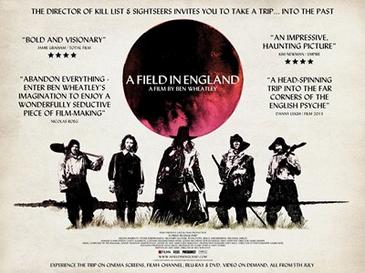
A Field in England

movie-poster


I bought my partner, C, Ben Wheatley's black and white seventeenth century psychedelic movie A Field in England for Christmas. We only recently got the chance to watch it as we have had house guests from before the holidays right through until last week; none of whom would have appreciated the film. Hence holding off watching it for nearly a month.

We've both wanted to see it since its release last July but, for a whole host of reasons, have been unable to. Needless to say we were both rather excited to finally get the chance. I have to say it was most definitely worth the wait.

If you haven't seen it yet here's the trailer.

http://www.youtube.com/watch?v=cRRvzjkzu2U

You can see why I describe it as a psychedelic film then?

The film follows three men in the midst of the English Civil War, two deserting soldiers and a scholar/magician, led into misadventure by a third soldier under the promise of leading them to an ale house. I don't want to say more than that about the plot to be honest. What I do want to highlight is the atmosphere of the film. Despite being filmed entirely out of doors in a picturesque English field the film still manages to feel extremely claustrophobic. There is a brooding menace to the film that consistently builds as events spiral ever more into a strange and macabre world devoid of reason. There is a scene in which one of the characters is attached to a rope, won't tell you any more than that, which is sincerely one of the most unsettling scenes I've ever seen in a film. Not because of the subject matter, the scene itself could just as easily have been comedic, but because of the disjointed feel of the scene. A mix of slow motion, frenetic energy, extreme close ups mixed with absolutely brilliantly emotive physical performances from the players is... well... it's unsettling! To say the least.

If you haven't seen this film rush out and do so at your first opportunity. The budget for this film was a mere £300,000. A figure that both shames many a director of big budget releases and is testament to Wheatley's brilliance as a director that such a low budget film should be such a masterpiece of horror cinema.

Wednesday, 15 January 2014

Kill It

I was going through photographs on my phone earlier today and cam across this image from when we(the family strange) moved from the house of slime and ichor(the words "damp problem" don't even describe it) to the rural idyll that we now occupy. When clearing out the garage we came across a horrific child's doll that was obviously the avatar upon this mortal plane of some unspeakable evil. So, being the civic minded people that we are, we..

KILLED IT WITH FIRE


Doll in Flames at Mouldy Slimeland


Which led me to thinking about the reasons why dolls have for so long been a staple of horror fiction, both in film and in literature. Something I shall have to return to when I have more than five minutes before I have to rush out of the door.

Hope you enjoyed the picture.

Thursday, 9 January 2014

Never Again

Weird fiction against racism and fascism.

~Allyson Bird and Joel Lane(eds.)


I spotted this on Goodreads recently and just couldn't resist.


From the back cover:


Can we ever say 'Never again' - and know that the atrocities of the past won't be repeated in the future? Here are 23 weird and speculative fiction stories against fascism and racism.


In today's unstable political and economic climate, the far right has gained a stronger political foothold in Europe than at any time since the 1930s. Its combination of racist rhetoric and street violence is a serious threat to our democratic culture and civil rights.


Never Again is an attempt to voice the collective revulsion of writers in the weird fiction genre against political attitudes that stifle compassion and deny our collective human inheritance. The imagination is crucial to an understanding both of human diversity and of common ground.


The anthology brings together stories by leading writers of weird fiction alongside new and radical voices: Ramsey Campbell, Lisa Tuttle, Joe R. Lansdale, Kaaron Warren, Rob Shearman, Tony Richards, Andrew Hook, Nina Allan, Gary McMahon, Stephen Volk, Simon Bestwick, Rosanne Rabinowitz, Rhys Hughes, David A. Sutton, Carole Johnstone, R.B. Russell, John Howard, Steve Duffy, Alison Littlewood, Simon Kurt Unsworth, Thana Niveau, Mat Joiner and rj krijnen-kemp.


These stories use imagination to look below the surface of intolerance, scapegoating and persecution - not to sicken the reader, but to reveal the power of human resistance and the need to build a society in which victimisation is a thing of the past.


Never Again is a non-profit initiative aimed at promoting awareness of these issues and raising funds to support human rights organisations.


I'm going to dive into this tomorrow. With all the nationalistic tub thumping and triumphalism that we, in the UK at least, are going to have to put up with over the next few years a dose of socially conscious weirdness should act as a nice counter balance.


Never Again is available from Gray Friars Press for £10(+PnP) or US$18(+PnP) with any and all profits being donated to The Sophie Lancaster Foundation, Amnesty International and P.E.N.

「Junk Head 1」

This wonderfully weird 30 minute stop motion animation was created over four years by Takahide Hori. It is a fantastic tale of the far future where humanity has achieved extreme long life at the expense of the ability to reproduce and has fought a war with a race of clones it created as a labour force.
In the distant future, humanity is hurtling down a path of ruin. Global environmental destructon caused by chemical contamination, radioactive fallout, and UV rays coming through the patchy ozone layer has lead to deterioration of the human genome.

In an attempt at escape, humans expanded their sphere of daily existence underground, but they were decimated by an ancient virus that had been sealed there.

However, by developing gene recombination technology using the virus’s genes, mankind was able to attain a lifespan that could be called “immortal.” The human body became inorganic at the molecular level. No breathing or blood circulation was necessary; as long as a faint electric stimulation was present, even existence as a disembodied head was possible.

(It was popular to change one’s body as fashion, and bodies that were no longer needed were fitted with AI heads and sold as laborers.)

However, mankind’s new atomic structure was unstable, so once every 10 years it had to be reconstructed. As long as that reset was accomplished, humans could expect “eternal” life, but in exchange, they lost the ability to reproduce.

In order to maintain their dwindling workforce, they started to create new beings patterned after humans using cloning technology, but the clones rebelled. At the end of a long war, a ceasefire was reached that has now lasted 1,200 years, with the two sides living separately: the humans on the surface and the clones below ground.
(However, at the border there are incessent skirmishes, and this story’s protagonist is unable to evade one of these attacks.)

The outbreak of a new virus saw the population reduced even further, and human society reached a critical point in the fight to preserve mankind.

It is during this crisis that a surveillence camera sent underground discovers clones that were unexpectedly able to reproduce, and an investigation is launched. (For population control reasons, clones were not originally built with reproductive functions...)

It is unclear how far the underground extends.

The ecology of the uniquely evolved clones is also unknown.

However, in order to carry on the species, mankind desperately needs that genetic information.

http://www.youtube.com/watch?v=ge18Ieyi9bI

Hori's website(in English) can be found here.

Sunday, 5 January 2014

Balcony

They gather about you. Their voices as full of gaiety as the music that drifts to the veranda from the gardens below; where the masked dancers continue their masquerade with gleeful abandon.


Reaching they touch your face. Fingers recoil slightly from the cold of skin on smooth clay chilled by the night air.


They have all removed their masks by now. The wearing of a gaudy disguise is only demanded when one is dancing in the gardens below. Here on the balcony the sparkling, bejeweled and feathered masks lie discarded in a pile beside an elaborately carved stone urn from which sprout tall green shoots topped by long finger like petals of deepest purple embracing a spindly golden stamen.


They gather around you. These pretty young things draped in chiffon and silk, barely into adulthood. Mere boys and girls thinking themselves so far removed from the innocence of what they considered to be their youths. Innocence that must be stripped away from them like the expensive and intricate masks they have so carelessly discarded to the floor.


A young woman asks why it is that you have not removed your mask.


Her companion recoils aghast, when it becomes clear that you wear.


No mask.


The first layer is peeled away.


Weird Horror Fiction

To say that I am a devotee of The Weird would be to understate the facts to a rather large degree. I have, since being a young teenager at least, been a fan of all manner of speculative fiction. Never content to focus on a single genre as some of my school mates seemed to I would, age 11 or 12, skip happily from reading the Hickman/Weiss Dragonlance fantasy novels to Clive Barker's Books of Blood to William Gibson's Sprawl novels. I never really discovered weird fiction however until my return to reading voraciously around seven years ago. Of course I read Lovecraft as a teenager, to have a diverse taste in genre fiction as a teenager makes it somewhat unavoidable, but I never came across any other writers of the weird.

Upon my return to reading(I lived out of a rucksack for many years, a state of affairs that makes reading a somewhat difficult task and one that is rather low on the priorities when weighed against finding somewhere dry to stay and food to eat) in around 2006/7 I dove straight back into genre fiction and before long inevitably found myself at Lovecraft's door once more. After reacquainting myself with the old racist from Providence I immediately set about trying to find work of a similar bent and discovered for the first time the wider world of Lovecraftian mythos writing.

I discovered the works of people like Willum Pugmire, Laird Barron and many, many others. I delved into writers who had influenced HPL such as Robert W Chambers and Arthur Machen. I have yet to read Lord Dunsany but he is most definitely on my 'to read' list for the next few years. It was around this time that I first of a literary movement describing itself as the New Weird. A literature that seemed to take elements of all the genre's I loved growing up and infected them with grotesqueries and body horror. That took genre tropes and turned them on their head whilst dipping them in decay and existential angst. Literature that takes the surreal and the monstrous by the hand and leads it to pastures strange and new. How could I not love this fiction and why was I only discovering it now? Years after it had apparently achieved its peak? Why only now do I find the works of Ligotti(THE modern master of horror and the weird), Kiernan, Mieville, Cisco and co.? It seems that I am, as ever, late to the party.

Faceless woman

woe is me


Regardless of my late arrival to the party of the weird I have wasted little time in exploring this new, to me, territory. This literary landscape of dreamlike confusion, tortured and twisted horror and screaming despair. Being somewhat new to this weird world I have spent nearly as much time reading about the field as I have done reading the actual works and authors discussed. I've devoured the writings of ST Joshi, Jeff VanderMeer et. al. as I've enjoyed interviews with the likes of Ligotti or talks by Mieville or the essays by publishers, critics, authors, bloggers and anyone with an interest in the fields of weird fiction writing.


What is it about the weird that kindles such a fire within? That makes me feel like the clichéd stranger in a strange land?


For me what makes a story weird is not the inevitability of the horror presented, the vast unknowable of Lovecraft's mythos, not the centrality of the city, of urbanism, to the story that many new weird writers claim. What truly defines a story as weird for me is that it leaves the reader discombobulated when they are done with the story.There should be no neat explanation of why a horror has occurred. The perceived real world should not remain intact when the story has unfolded. It should be made askew, unhinged. It is a simple enough affair for a human mind to adapt to the existence of creatures of myth and legend. For ghosts, vampires, werewolves, and bogeys to be accepted into our world view. We have, after all, been raised on such creatures. They are as much a part of our psychic world as the myths of nationalism and the stories that we tell ourselves to create the shared world we all inhabit. A weird tales does not necessarily tear down these edifices of society, though some do, it instead ruptures them. It tears at the ragged hem of what our perceived reality exposing something else. Some equally, or even more, real than the supposedly real world around us.


surreal mirror imageThat is of course when the weird fiction tale is set in a world that is either ostensibly our own, as in the works of Lovecraft, Machen and so on, or is so like our own that one need not distinguish it as being secondary world fiction as in the works of Ligotti. What then of the secondary world weird tale? When an author is set upon setting the world askew why only concentrate upon a world like the one in which we live when we have, as a species, created countless worlds in which to set stories. We can take these worlds of fantasy and science fiction and set them spinning to see what happens. What happens is, of course, authors like Jay Lake and China Mieville and Michael Cisco. These authors take the worlds created by speculative fiction authors and do for these fictional worlds what Ligotti et al. do for the one in which we live.


This is why I am a devotee of the weird. Because it is always new(hackeyed pastiches of Lovecraft notwithstanding) and always unexpected. It forces the reader to move beyond the comfort zone of familiar tropes and idioms. Because it uses these tropes and idioms to subvert themselves and the society that created them.


So here's to discombobulation and the rupturing of the real to expose the real.


Saturday, 4 January 2014

New year.

New blog.


Old world.

Old.


So it goes that the technicolor vibrancy of the festive season is blanched to something approaching the washed out tepidity of normality. A new year and a new blog to hold my gauche mutterings until the next time I tire of this and do my best to remove it from the internet. This will be less a place of "sharing" than place holder for various thoughts and conjectures as I attempt to pull some form of creative work from my skull. A place for passing thoughts on the grotesque and the horrific. The weird.

Obviously, should my head release anything I want others to cast their eyes over then I shall place it here in one form or another.

Found on Google Plus